
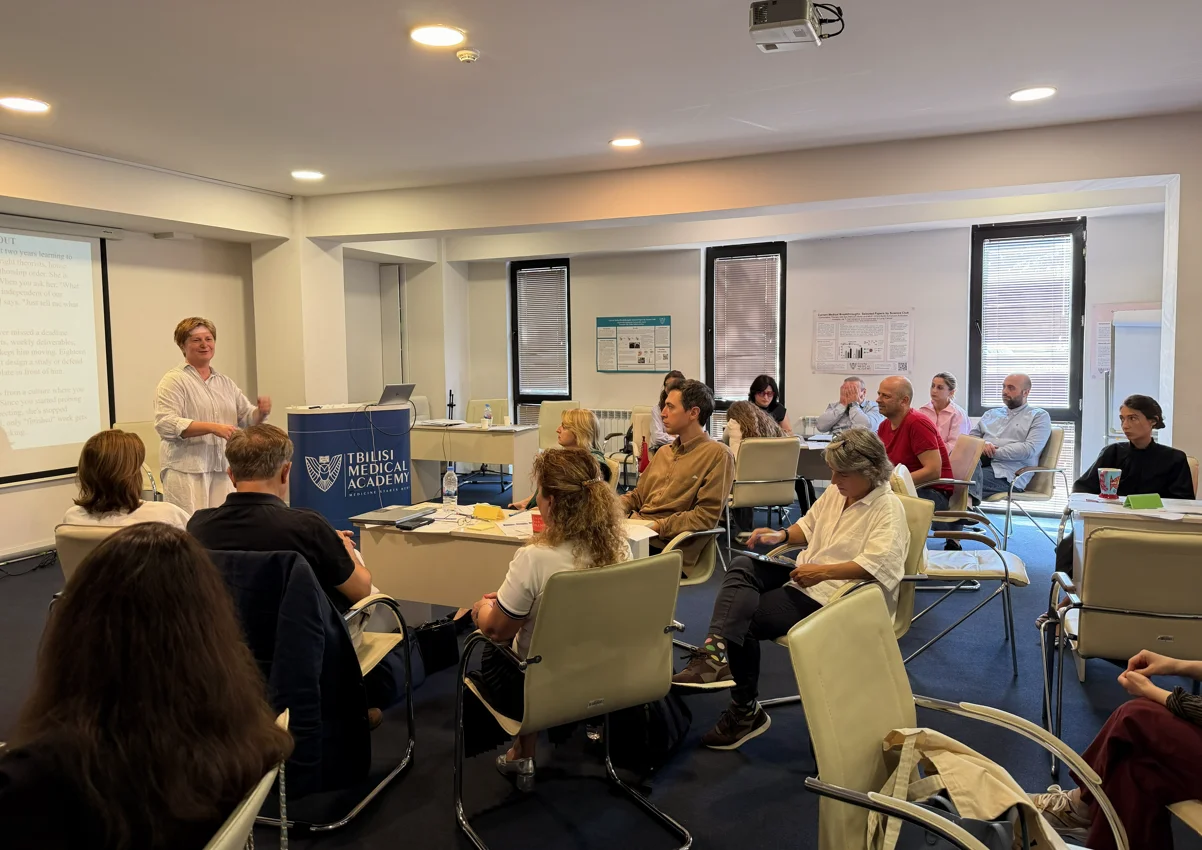
On September 1-4 2026, ARIVE organised a four-day Training of Trainers programme at Petre Shotadze Tbilisi Medical Academy, Tbilisi, Georgia, dedicated to research supervision, facilitation and team-based virtual research learning.
ARIVE (Advancing Research and Innovation in Higher Education through Virtual Exchanges) is an Erasmus+ project aimed at establishing high-quality virtual research opportunities for students and early-career researchers in the fields of health sciences and related scientific disciplines. The project seeks to strengthen the international research capacity of participating institutions through the implementation of structured virtual research semesters, training activities focused on the use of digital technologies and artificial intelligence for research purposes, and international academic mentorship. Moreover, the project promotes interdisciplinary research, the development of inclusive academic networks, and the implementation of joint scientific projects.
The training was led by Professor Rob Bongaardt and Professor Etty Nilsen from the University of South-Eastern Norway and brought together ARIVE partner universities and research institutions from Latvia, Portugal, Norway, Ukraine, and Georgia as the project prepares for the next stage of implementation.The programme focused on a key question for ARIVE: how can supervisors and academic staff support students and early-career researchers in a Virtual Research Semester, where learning takes place through collaboration, inquiry, dialogue and research practice?
During the training, participants explored research-based approaches to supervision, motivation, psychological safety, interdisciplinary teamwork and facilitation. Instead of relying on long lectures, the programme used active learning methods, including individual reflection, small-group work, case discussions, plenary dialogue and practical exercises. A particular focus was placed on the role of supervisors and mentors in supporting research teams. Participants discussed how to create conditions where learners feel ownership of their work, make progress, feel connected to others and learn to navigate different disciplinary perspectives.
The Training of Trainers also reflected the working methods that will be used in ARIVE’s Virtual Research Semesters. Participants were encouraged to think not only about what should be taught, but how research learning can be facilitated in a virtual, interdisciplinary and international environment. The final part of the programme focused on practice. Participants worked in groups to design and facilitate short sessions linked to different stages of the Virtual Research Semester, including team formation, development of research questions, use of AI as a team member, interdisciplinary reasoning, feedback and reflection.
The ToT represents an important step in preparing ARIVE’s academic community for future learning activities. It supports the development of a shared pedagogical approach across the consortium and strengthens the project’s capacity to deliver meaningful, well-supported and collaborative virtual research education.
Through this training, ARIVE continues to build the human foundation of virtual exchange: supervisors, mentors and academic staff who can guide learners not only through research tasks, but through the process of becoming more confident, reflective and collaborative researchers.