
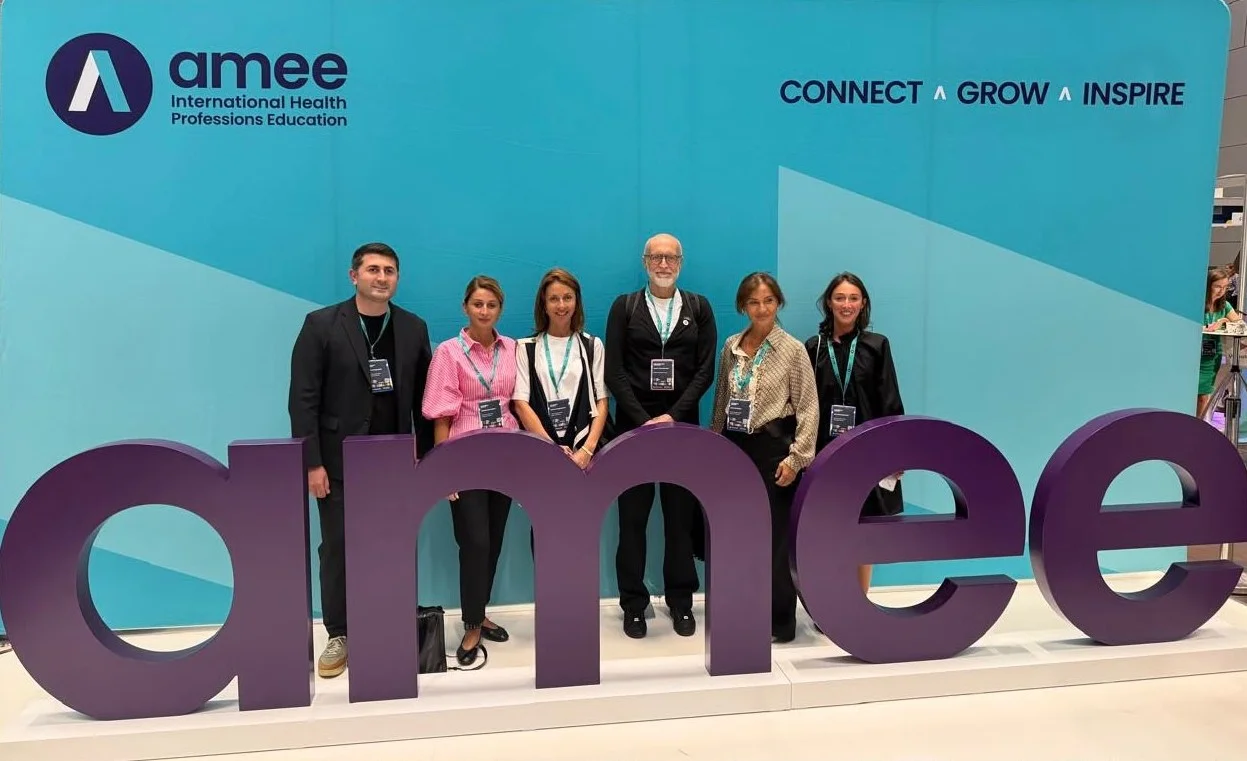
For our team and faculty members, participation in AMEE 2026 in Vienna, Austria, 22-26 August, was an opportunity to connect global developments in health professions education with the educational ecosystem we are building at Petre Shotadze Tbilisi Medical Academy.
The TMA team at AMEE 2026 included: Irene Shotadze, Rector; Ana Mamiseishvili, Rector's Current Affairs Coordinator; Kakha Bregvadze, Co-Head of One-step Educational Programmes; Maka Maglakelidze, Co-Head of the Institutional Culture Development Department; Tinatin Akhvlediani, Deputy Dean for Student Affairs.
Held under the theme “Educators as Catalysts: Building the Future of Health,” the conference brought together educators and health professionals to explore how education can shape not only future clinicians, but also the healthcare systems and societies they will serve. Themes including faculty development, authentic assessment, humanities, equity, patient safety, technology-enhanced learning, sustainability, and global health closely intersect with our priorities for education quality enhancement and institutional development.
Among the topics particularly relevant to our work was “Catalysts for Global Learning: Building a Cross-Cultural Research Framework for Arts-Based Health Professions Education.” It reflects an approach we are increasingly embedding in our own educational ecosystem: medicine cannot be taught exclusively through biomedical knowledge or within clinical walls.
Our initiatives such as “Six Days of a Country Doctor” and “Teaching Medicine and Empathy Through Art” connect medical education with community experience, humanities, empathy, and the lived realities of patients. Through these experiences, students are encouraged to understand healthcare not only as a clinical service, but as a social responsibility.
This creates opportunities for interdisciplinary and transdisciplinary teaching and learning, where medicine intersects with the humanities, social sciences, community engagement, ethics, and the arts. The outcome is a broader conception of what it means to become a physician and a stronger connection between academic learning and the needs of society.
From international insight to educational improvement
AMEE's focus on authentic assessment, faculty development, learning design, and patient safety also provides relevant perspectives for the continued enhancement of our educational practices.
The value of participation lies in what can be brought back into our academic environment: approaches that can inform curriculum development, strengthen assessment of clinical competencies, support faculty development, and enrich teaching and learning.
We aspire to develop TMA as an educational gravitational center, where medical education, clinical practice, research, innovation, and societal engagement reinforce one another rather than operate as separate activities.
Partnerships with purpose
AMEE 2026 also strengthened our international engagement and created opportunities to develop relationships with educators and institutions beyond existing networks.
For us, internationalisation is not simply about increasing the number of partnerships. We seek shared-value partnerships that generate tangible outcomes: faculty development, student opportunities, collaborative educational initiatives, research, knowledge exchange, and measurable improvements in teaching and learning.
In this sense, international engagement becomes part of our quality enhancement strategy and contributes directly to the development of our educational ecosystem.
Giving the Third Mission practical meaning
The ideas explored in Vienna also reinforce our commitment to the Third Mission of a medical university: connecting education and research with society and translating knowledge into meaningful public value.
Our socially responsible projects provide a practical foundation for this mission. They give students opportunities to engage with communities, develop empathy, understand health beyond the hospital, and apply their knowledge to real-world challenges.
AMEE 2026 therefore offered more than exposure to international trends. It strengthened a direction already emerging within our institution: building an educational environment where interdisciplinary and transdisciplinary learning, international collaboration, faculty development, and social responsibility converge to improve the experience and outcomes of medical education.
For our community, the measure of international engagement is ultimately what happens after returning home: what we improve, what we create together, and what our students are better prepared to do because of it.